
Generic topical drug products must demonstrate bioequivalence to their reference product before they can be approved. One of the EMA-approved techniques for this purpose is tape stripping (TS): repeatedly applying and removing adhesive tape to peel off layers of the stratum corneum and quantify how much active ingredient has penetrated the skin. TS is well established, but it is also invasive, costly and labour-intensive.
Confocal Raman spectroscopy (CRS) has been proposed as a non-invasive, in vivo alternative to TS: it measures the concentration of an active ingredient in the skin. Evaluating CRS within the study design that the EMA guideline sets out for bioequivalence is therefore an important step towards its consideration in a regulatory context.
In the study titled “A pivotal, dermal, in-vivo bioequivalence study performed by confocal Raman spectroscopy (CRS)” (J. Link, C. Heusel, D.J. Lunter, 2025), researchers from the University of Tübingen carried out such an evaluation, applying the design and acceptance criteria of the European Medicines Agency (EMA) guideline on quality and equivalence of locally applied, locally acting cutaneous products. The authors conclude that their results support the use of in vivo Raman measurements to assess the bioequivalence of topically applied products containing Raman-active ingredients.
The study was carefully structured to evaluate confocal Raman spectroscopy’s ability to assess bioequivalence between topical formulations under controlled conditions, following the design requirements of the EMA guideline (EMA/CHMP/QWP/708282/2018).
Twelve healthy volunteers (4 males and 8 females) took part, testing three formulations containing salicylic acid (SA):
Two critical time points captured both drug uptake and clearance:
The reference product was applied to two different skin sites on each subject. Products were applied to designated areas on the left and right forearms, including:
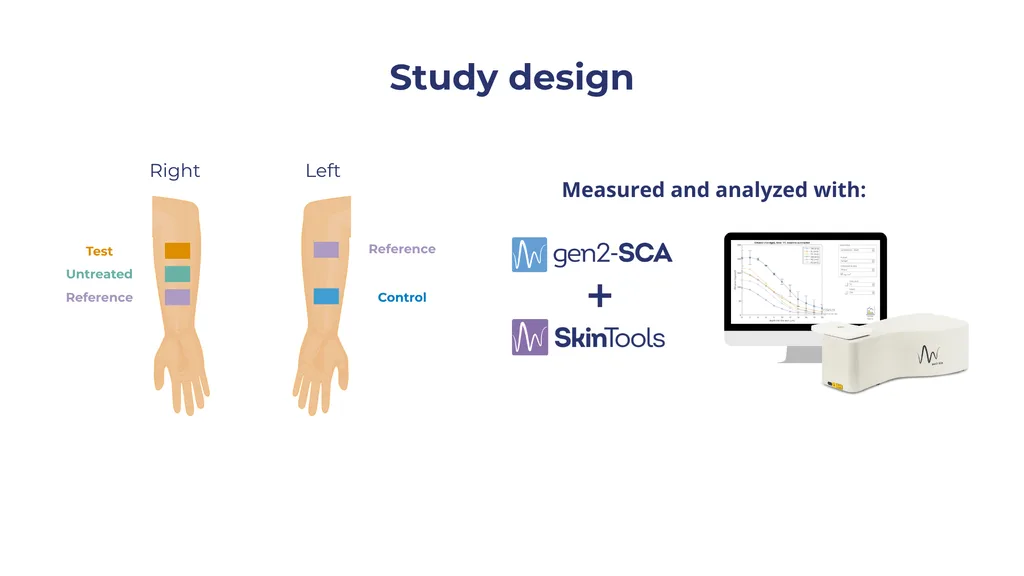
Raman measurements were performed using RiverD’s gen2-SCA Skin Composition Analyzer, and all data were analyzed using SkinTools software, allowing quantitative comparison between formulations.
The Raman measurements provided detailed penetration profiles for each formulation at both time points.
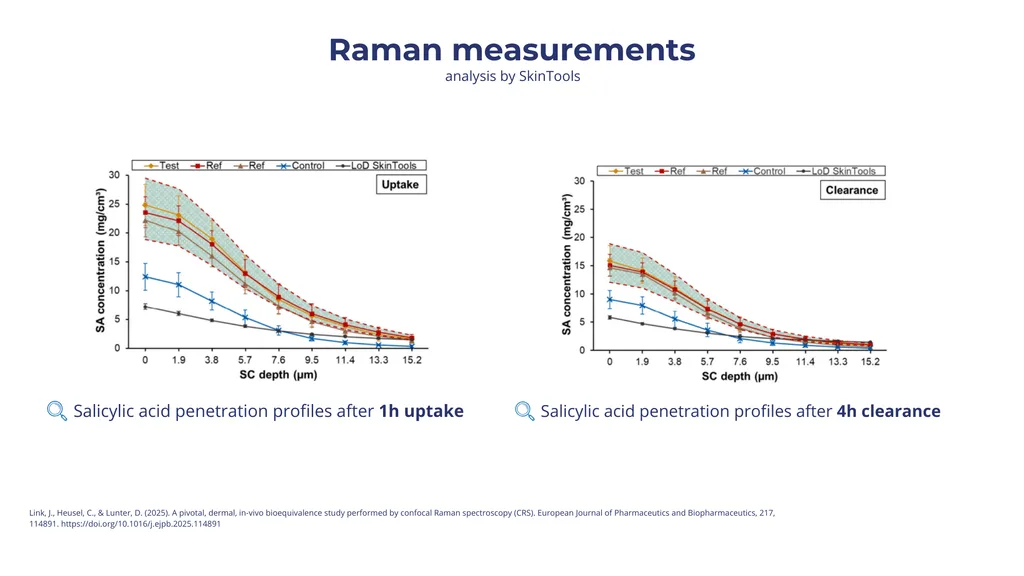
The key outcomes were:
The results suggest that confocal Raman spectroscopy offers a non-invasive alternative approach to the bioequivalence assessment of topical products. As the authors point out, CRS is not yet an approved method. They hope their data will contribute to its recognition in a future update of the EMA guideline.
This study provides, for the first time, pivotal evidence that in vivo Raman spectroscopy can support bioequivalence assessment, while meeting EMA bioequivalence evaluation requirements.
The study was funded by the German Federal Ministry for Economic Affairs and Climate Action.
The authors declare that they have no known competing financial interests or personal relationships that could have appeared to influence the work reported in this paper.
Explore the study here: A pivotal, dermal, in-vivo bioequivalence study performed by confocal Raman spectroscopy (CRS) – ScienceDirect.
Read more about our RiverD studies on topically applied products:
